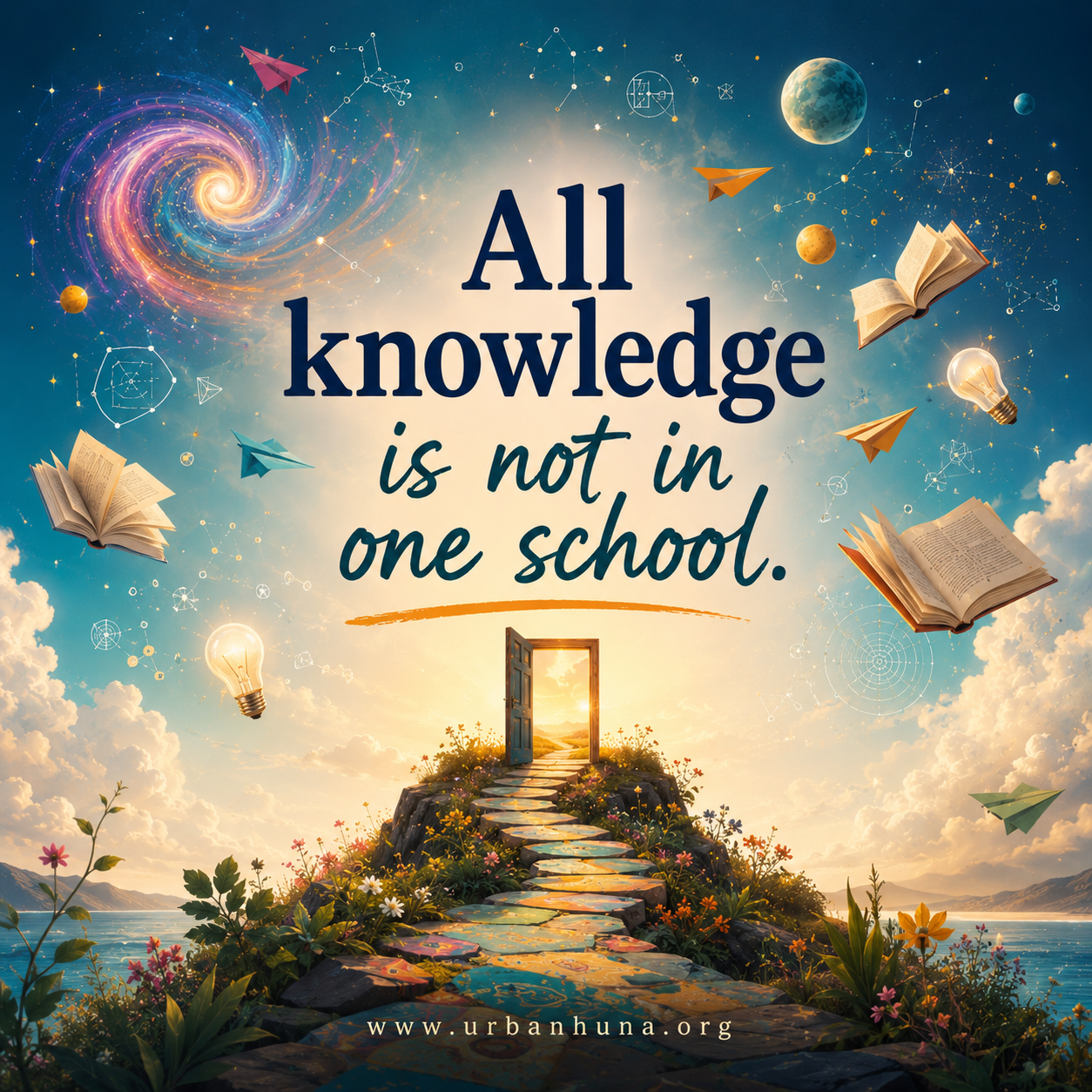
This Hawaiian saying is often translated as: “All knowledge is not in one school.” It is a simple phrase, yet one that contains a great deal of wisdom. The older I get, the more I find myself returning to it.
Most of us have had moments where something valuable arrived from an unexpected direction. Perhaps it was a conversation with somebody outside our usual circles. A book we almost ignored. A different spiritual perspective. A practical idea from psychology, philosophy, science, or even gardening. Sometimes the insights that help us most do not arrive through the door we expected.
At the same time, many of us have also absorbed the idea that truth belongs in one place. One system. One tradition. One authority. One approved way of seeing the world. That can create certainty, but it can also quietly reduce our sense of curiosity and exploration.
From a Huna perspective, openness to learning matters deeply. Not because every idea is equally useful or wise, but because life itself is constantly offering opportunities to see differently, grow, adapt, and deepen our understanding. When we become too rigid in our thinking, we can begin relating more to our existing beliefs than to life itself.
One of the things I have always appreciated about the lineage of Huna that I work within is its practical spirit. There is an attitude of experimentation within it. Rather than demanding rigid belief, there is an encouragement to stay curious, notice what creates more harmony or effectiveness, and remain willing to learn.
This connects strongly to the Huna principle of Pono. One of the concepts behind Pono is effectiveness, and one of the ways I understand it is that experience matters. It is not only what sounds convincing intellectually that counts. What matters is also what helps people live with greater awareness, kindness, harmony, resilience, connection, and clarity.
That does not mean chasing quick fixes or assuming that whatever feels good in the moment must be true. Discernment still matters. But Pono invites us into a living relationship with wisdom rather than a rigid attachment to fixed ideas.
Questions such as these become important:
Does this way of thinking help me relate to life more wisely?
Does this practice create more openness or more fear?
Does this teaching encourage responsibility and compassion, or dependency and rigidity?
Does it actually help in lived experience?
In this sense, Huna is not a collection of spiritual beliefs. It is about participation with life. We learn through observation, through relationship, through trying things out, through reflection, and through remaining willing to revise our understanding when experience teaches us something new.
Years ago, when I first hosted Serge King in the UK for a workshop, I spoke to several people who indicated that they were interested in attending. However, they explained that before they could come, they first needed permission from their teacher.
As it happened, their teacher told them they were not allowed to attend.
I remember finding that situation deeply curious. Not because everybody has to agree with Serge’s teachings, and certainly not because every teacher or approach is right for every person. Different paths resonate differently with different people. Discernment matters.
What struck me, however, was the idea that exploration itself had become something dangerous. When people feel unable to look outside one approved body of knowledge, something important can begin to close down inside them. Curiosity becomes restricted. Thinking becomes narrower. The freedom to discover something new becomes limited.
To me, genuine empowerment includes the freedom to explore, question, think, and discover for ourselves. That does not mean believing everything we encounter. In fact, openness without discernment can become just as unhelpful as rigidity without openness. But there is a middle path where curiosity and grounded thinking can exist together.
A healthy teacher, tradition, or system should not need to isolate people from all outside influences in order to survive. If something has genuine value, exploration will often deepen understanding and sustain it rather than destroy it.
Human culture itself has always evolved through exchange. Ideas move between people and cultures. Practices adapt over time. Stories travel. Knowledge develops because human beings share, refine, borrow, combine, and create.
Much of what benefits humanity today emerged because somebody was willing to look beyond the boundaries of what they already knew. Medicine developed through shared discoveries across different cultures. Psychology borrowed from philosophy, spirituality, neuroscience, storytelling, and lived experience. Music evolved through influences meeting one another and creating something new.
Even in everyday life, learning often happens this way. We hear one idea in one place and another idea somewhere else, and suddenly something clicks into place in a way it never had before. Serendipity is a wonderful thing!
Sometimes people worry that exploring different traditions somehow weakens authenticity or commitment. Yet often the opposite happens. Exploring different perspectives can help us understand our own path more consciously. It can reveal blind spots. It can deepen appreciation. It can remind us that no system contains the entirety of truth.
This does not mean all ideas are equally wise or useful. Clearly they are not. But refusing to explore at all can also become a form of limitation.
Being open to learning from many sources does not mean abandoning intelligence or discernment. Some teachings create greater openness, resilience, humour, compassion, and effectiveness. Others can create more fear, superiority, dependency, confusion, or rigidity.
The principle of Pono encourages us to notice results. What actually happens when an idea is lived? How does it affect relationships, wellbeing, awareness, responsibility, and connection with life?
These questions matter because it is easy to become attached to ideas that sound impressive while overlooking whether they genuinely help people live more wisely.
At the same time, it is important to remain compassionate with ourselves. Most of us cling to certainty sometimes. Most of us become attached to familiar ways of seeing. This is part of being human. The invitation is not to judge ourselves for that, but simply to notice when curiosity has quietly closed down.
Often the most valuable insights arrive when we become willing to loosen our grip slightly and allow another perspective to enter the conversation.
This principle is not limited to spiritual teachings. It appears everywhere in ordinary life.
Perhaps somebody learns more about peace of mind through tending a garden than through years of reading self-help books. Perhaps a scientific documentary unexpectedly deepens somebody’s sense of awe and wonder. Perhaps a conversation with an older relative changes how a person understands love or grief. Perhaps a poem, a myth, a film, or a walk by the sea suddenly helps something fall into place internally.
Life teaches through many different voices.
Sometimes wisdom arrives through joy. Sometimes through struggle. Sometimes through stillness. Sometimes through complete surprise. The more tightly we insist that truth must only appear through one approved channel, the more we may miss the richness of what life is already offering.
When we become more open, the world can begin to feel more alive and conversational as though we are in an ongoing dialog and exploration. We start relating to life itself as teacher rather than assuming wisdom only exists inside certain books, teachers, or systems.
1. Explore Outside Your Usual World
Choose something outside your normal area of interest. It might be a book, podcast, conversation, documentary, or workshop. You do not need to agree with everything you encounter. Simply notice what ideas resonate, what challenges you, and what questions arise.
2. Ask “What Can I Learn Here?”
When something unexpected happens this week, try asking yourself: “What might life be showing me here?” Not every experience contains a grand spiritual lesson, but many experiences contain useful insights if we approach them with openness.
3. Notice Areas of Rigidity
Gently observe where you may have become overly fixed or certain. This is not about criticising yourself. We all do this at times. Simply notice whether there are areas where curiosity has become restricted.
4. Test Through Experience
Rather than endlessly debating ideas intellectually, experiment gently where appropriate. Notice the actual effects in your experience. Sometimes lived experience teaches more deeply than theory alone.
No single teacher, philosophy, school, or tradition can fully contain the mystery of life. Each offers a perspective, a language, and a map. Some maps may fit us better than others at different stages of life.
From a Huna perspective, perhaps wisdom involves learning how to remain open without becoming lost, grounded without becoming rigid, and curious without becoming naïve.
There is always more to learn. Always another perspective that may reveal something useful. Always another doorway that may unexpectedly open.
Sometimes the very insight we need arrives from a place we had not previously considered looking. And sometimes the simple willingness to remain curious becomes a quiet form of freedom.