Think of a time you set off somewhere new. It doesn’t have to have been far away. It might just have been a new path on a familiar walk, a different route to work, a door you had never opened before. There is usually a moment just before you start when you do not quite know what you will find. That small, uncertain moment, right before the first step, is where every adventure actually begins.
I think the same is true of an inner adventure. Most of us spend our days running on autopilot, using only a small part of who we really are. Underneath that everyday surface, though, there is something quieter and more capable: a kind of natural intelligence, a subtle sense of guidance, a steadier place to stand than we usually notice we have.
Huna is simply a gentle, practical way of finding your way to that part of yourself.
One of the things I find most freeing about Huna is what it is not. It is not a dogmatic set of beliefs, and there is nothing you are asked to take on faith. It works more like a set of lenses you can look through, along with some small, real practices you can try for yourself and simply keep whatever proves useful. Nothing here needs previous experience, and nothing needs you to believe anything in particular first. Just curiosity, and a willingness to explore.
Within that way of seeing, a few ideas keep showing up, quietly underpinning almost everything else.
At the heart of Huna are seven simple principles: Ike, Kala, Makia, Manawa, Aloha, Mana and Pono. Each one is really just a lens on how the mind and life seem to work. Ike, for instance, points to the idea that the world you experience is shaped by what you believe about it. Makia points to the power of attention, that energy tends to flow where your focus goes. None of them are complicated on their own, but they overlap and reflect each other in interesting ways, so that noticing one often brings a little more clarity to the others too.
Huna also offers a simple map of who we are, made up of three selves working together. There is the everyday conscious self, the one doing the thinking and choosing. There is a deeper, more instinctive self, closer to the body and the emotions, that holds memory and habit. And there is a higher, wiser self, the part that seems to have a broader view than we usually have access to day to day. Getting to know how these three parts of you communicate, or sometimes fail to, is often where real change quietly begins.
Another useful lens Huna offers is the idea that reality shows up on four levels at once: the world as it literally is, the world as we perceive it, the world as we believe it to be, and the world as we would like it to be. Most friction in life happens somewhere between these levels, when what we believe is possible does not match what actually is. Simply noticing which level you are operating from in a given moment can be surprisingly clarifying.
Finally, Huna carries some simple, practical basics around healing, not as a replacement for medical care, but as a complementary way of working with the mind, the emotions and the body together. Much of it comes back to relationship: with your own feelings, with your body’s signals, and with the people around you. Nothing dramatic or complicated, just a steadier way of tending to yourself.
You don’t need to take any of this on faith to explore it. Here are a few small ways in:
None of this needs to be worked out all at once. Huna tends to reveal itself gradually, one small noticing at a time, rather than through a single dramatic insight. That quieter, more capable part of you is not somewhere far away. It is usually right there, just beneath the surface of an ordinary day, waiting for the moment you decide to take that first uncertain step towards it.
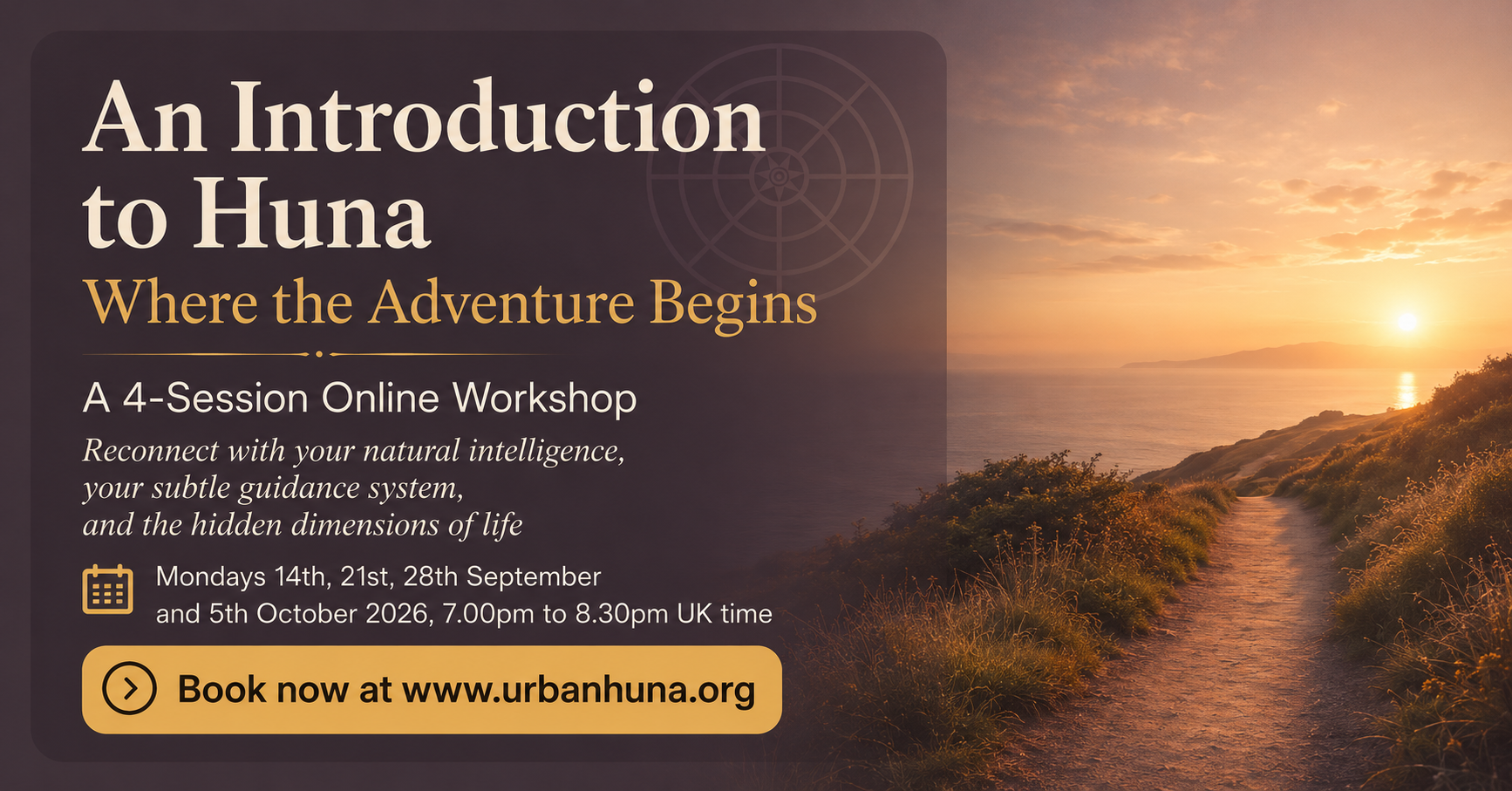
If you would like company for that first step, Stewart Blackburn and I have brought back our four part introductory course this September, built for anyone taking their first steps into Huna. We explore the Seven Principles, the Three Selves, the Four Levels of Reality and the basics of healing together, over four live online sessions. You can find the details on the events page at https://www.urbanhuna.org/events/ whenever it feels like the right moment for you.
And if you have already taken this class before and want to come back for a refresh (after all no two classes are the same) there is a 50% discount, just contact me for details.
Happy Huna Adventures,
Pete